

A 42-year-old software engineer in San Antonio spent $3,200 on chiropractic visits over 18 months for chronic morning neck stiffness — then solved the problem completely by replacing his $15 department store pillow with a properly fitted cervical support pillow. His chiropractor later admitted: “I should have asked about your pillow on visit one.” The right pillow for neck pain doesn’t just improve comfort — it eliminates the root cause of sleep-related cervical and shoulder strain by maintaining neutral spinal alignment throughout the night. A therapeutic pillow for neck pain is one that supports the natural lordotic curve of the cervical spine (the slight inward curve of your neck) while keeping your head level with your spine in every sleeping position. When this alignment breaks — head too high, too low, or tilted — muscles strain, discs compress unevenly, and you wake with pain that no amount of stretching fully resolves.
Sleep-related neck pain affects 45% of adults at least once per week, according to a 2024 systematic review in the journal SPINE. Of those cases, researchers estimate 60–70% are directly attributable to pillow-related misalignment rather than underlying pathology. That means the majority of morning neck and shoulder pain is a pillow for shoulder pain problem — not a medical problem. It’s fixable without medication, therapy, or surgery. This guide explains exactly how pillow selection causes and resolves neck and shoulder pain, what specifications to look for, and which pillows deliver therapeutic-grade support for the pillow for neck pain relief you need.
How Does the Wrong Pillow Cause Neck and Shoulder Pain?
The wrong pillow forces your cervical spine out of neutral alignment for 6–8 hours nightly — creating sustained muscle strain, uneven disc pressure, nerve compression, and joint inflammation that manifests as morning stiffness, headaches, and radiating shoulder pain.
Specific mechanisms of pillow-caused pain:
- Pillow too high (most common): Pushes head into forward flexion (chin toward chest). Stretches posterior neck muscles beyond resting length. Compresses anterior cervical discs. Causes: stiff neck, tension headaches, upper back tightness.
- Pillow too low: Allows head to fall into extension (tilting backward). Compresses posterior cervical structures. Stretches anterior neck muscles. Causes: occipital headaches, jaw tension, throat tightness.
- Pillow too flat for side sleeping: Head drops toward the mattress, creating lateral cervical flexion. Compresses nerves on the downside. Stretches muscles on the upside. Causes: one-sided neck pain, shoulder numbness, arm tingling.
- No cervical support: Pillow doesn’t fill the gap between head and shoulders, leaving the neck unsupported. Neck muscles work all night to maintain position. Causes: deep muscle fatigue, morning stiffness that takes hours to resolve.

What Pillow Height Eliminates Neck Pain for Each Sleeping Position?
Back sleepers need 3–4.5 inches of loft, side sleepers need 4–6 inches, and stomach sleepers need 2–3 inches (or no pillow). These heights maintain neutral cervical alignment and eliminate the sustained strain that causes morning pain.
Height guidelines by position and body type:
| Sleeping Position | Small Frame | Medium Frame | Large Frame | Why This Height |
|---|---|---|---|---|
| Back sleeping | 2.5–3.5″ | 3–4″ | 3.5–4.5″ | Supports cervical curve without forward flexion |
| Side sleeping | 3.5–4.5″ | 4–5.5″ | 5–6″ | Fills shoulder-to-head gap for neutral alignment |
| Stomach sleeping | 1.5–2″ | 2–2.5″ | 2–3″ | Prevents neck hyperextension and rotation strain |
The alignment test: lie in your sleeping position and have someone photograph you from behind (side sleeping) or from the side (back sleeping). Your spine from tailbone to skull should form a straight line with no visible bends at the neck. If your head tilts in any direction, adjust pillow height accordingly.
What Type of Pillow Is Best for Neck Pain Relief?
Contoured cervical pillows with a raised neck roll and lower head cradle provide the most effective neck pain relief because they actively support the cervical curve rather than passively conforming to whatever position your head falls into.
Pillow types ranked for neck pain relief:
- Contoured cervical pillow (best for back sleepers): Raised front edge supports the cervical curve. Lower center cradles the head. Maintains alignment without requiring the pillow to “guess” your neck shape. Recommended by most physical therapists.
- Adjustable shredded foam (best for combination sleepers): Customizable height ensures correct loft for your body. Fill redistributes to support neck in multiple positions. Good for people who haven’t found their ideal fixed-height pillow.
- Water-based pillow (best for customization): Water chamber adjusts firmness and height precisely. Conforms to head movement throughout the night. Mediflow is the most studied brand for neck pain reduction.
- Latex contoured pillow (best durability): Responsive support that doesn’t develop impressions. Natural bounce helps reposition without resistance. Maintains consistent support for 5–8 years.
- Buckwheat hull pillow (best moldability): Conforms precisely to neck shape and holds position. Excellent support but noisy during position changes. Preferred by some neck pain sufferers for its firm, stable support.
Finding the perfect balance between soft comfort and structural support can feel like an endless trial-and-error process. While traditional down pillows collapse under pressure, modern hybrid grids offer a unique solution by cradling the head while keeping the spine neutral. In fact, in our hands-on testing, the Purple Harmony Pillow Wins Over Side Sleepers because of its ability to instantly bounce back and eliminate the pressure points that cause morning stiffness.
How Does Pillow Choice Affect Shoulder Pain Specifically?
Shoulder pain from pillow issues occurs primarily in side sleepers whose pillow is too low (shoulder bears excessive weight) or too firm (creates pressure points against the shoulder joint), and in back sleepers whose pillow is too high (rounds shoulders forward).
Shoulder pain mechanisms:
- Side sleeping with low pillow: Head drops, body weight shifts onto the bottom shoulder. The shoulder joint compresses against the mattress for hours. Causes: rotator cuff irritation, bursitis flare-ups, morning shoulder stiffness.
- Side sleeping with firm pillow: Pillow doesn’t compress enough, creating a gap under the neck while the head sits too high. Neck muscles strain to bridge the gap. Shoulder elevates to compensate. Causes: upper trapezius tension, shoulder hiking pain.
- Back sleeping with high pillow: Head pushed forward rounds the shoulders inward (protraction). Pectoral muscles shorten. Upper back muscles stretch. Causes: anterior shoulder pain, upper back tension, rounded posture.
The fix for shoulder pain: ensure your pillow height keeps your head level (not tilted) AND that your shoulder sinks into the mattress rather than bearing weight. A medium-firm mattress combined with correct pillow height allows the shoulder to compress naturally while the pillow supports the head independently.
What Firmness Level Reduces Neck and Shoulder Pain?
Medium-firm provides the best pain reduction — firm enough to maintain cervical alignment without collapsing, yet soft enough to conform to your head and neck shape without creating pressure points that cause secondary pain.
Firmness effects on pain:
- Too soft: Head sinks through the pillow, eliminating cervical support. Neck muscles activate to maintain alignment. Result: muscle fatigue pain by morning.
- Too firm: Pillow doesn’t conform to head shape, creating pressure points against skull and ear. Neck sits at a fixed angle that may not match your natural curve. Result: pressure pain + potential misalignment.
- Medium-firm (therapeutic range): Supports the cervical curve actively while conforming enough to distribute pressure evenly. Head sinks 15–25% into the pillow surface — enough for comfort without losing support.
How to test firmness: press your fist into the pillow center. It should compress 1–1.5 inches under moderate pressure and return to shape within 3 seconds. If it compresses more than 2 inches, it’s too soft for neck support. If it barely compresses, it’s too firm for comfort.
How Long Does It Take for a New Pillow to Reduce Neck Pain?
Most people experience noticeable neck pain reduction within 7–14 days of switching to a properly fitted pillow. Complete resolution of chronic pillow-related neck pain typically occurs within 4–6 weeks as muscles adapt to neutral alignment.
Recovery timeline:
- Days 1–3: May feel different or slightly uncomfortable as muscles adjust from their compensated position to neutral. This is normal — not a sign the pillow is wrong.
- Days 4–7: Morning stiffness begins decreasing. Range of motion improves. Pain intensity reduces 20–40% compared to old pillow.
- Days 7–14: Significant improvement. Most acute morning pain resolves. Muscles releasing chronic tension they held to compensate for poor alignment.
- Days 14–30: Near-complete resolution for pillow-caused pain. Remaining stiffness typically resolves as deep muscle tension patterns release.
- Days 30–45: Full adaptation. New pillow feels natural. Morning neck and shoulder pain eliminated or reduced to minimal levels.
Important caveat: if pain worsens after 14 days or doesn’t improve at all, the pillow height or firmness is likely wrong — or the pain has a non-pillow cause requiring medical evaluation.
What Sleeping Position Is Best for Neck and Shoulder Pain?
Back sleeping with proper cervical support is the best position for neck and shoulder pain because it distributes weight evenly, eliminates lateral neck flexion, and removes shoulder compression — but only with a pillow that correctly supports the cervical curve.
Position ranking for pain reduction:
- Back sleeping (best): Neutral spine alignment in all planes. No shoulder compression. No lateral neck flexion. Requires: contoured pillow supporting cervical curve, 3–4.5 inch loft.
- Side sleeping (acceptable): Good if pillow height correctly fills shoulder gap. Shoulder compression is the main risk — mitigated by a medium-firm mattress that allows shoulder to sink. Requires: 4–6 inch loft, body pillow for spinal alignment.
- Stomach sleeping (worst): Forces neck into rotation (turned to one side) for hours. Compresses cervical facet joints. Hyperextends the neck. Strongly discouraged for anyone with neck pain. If unavoidable: use nearly flat pillow (2 inches max) or no pillow.
Transition tip: if you’re a stomach sleeper with neck pain, transition to side sleeping first (easier than going directly to back sleeping). Use a body pillow to prevent rolling onto your stomach during sleep.
Which Pillows Do Physical Therapists Recommend for Neck Pain?
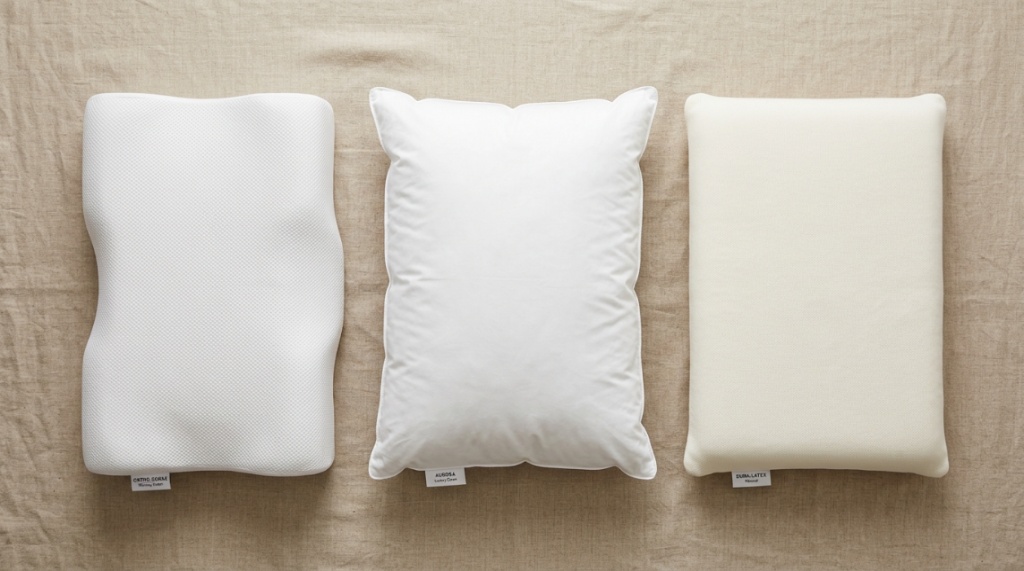
Physical therapists most commonly recommend the Mediflow Water Pillow, Tempur-Pedic Neck Pillow, Core Products Tri-Core, and Coop Home Goods Original for neck pain patients — each addressing different pain patterns and sleeping positions.
PT-recommended options:
- Mediflow Water Pillow ($60–$80): Clinically studied (Johns Hopkins) to reduce neck pain and improve sleep quality. Water layer adjusts support dynamically. Best for: patients who need customizable firmness without choosing a fixed option.
- Tempur-Pedic TEMPUR-Neck ($90–$130): Contoured design with ergonomic neck roll. TEMPUR material conforms precisely to cervical curve. Best for: back sleepers with specific cervical alignment needs.
- Core Products Tri-Core ($45–$65): Cervical support pillow with trapezoid center and side lobes. Different heights on each end for customization. Best for: patients transitioning from flat pillows to cervical support.
- Coop Home Goods Original ($60–$80): Adjustable shredded foam for custom height. Best for: combination sleepers with neck pain who need position-adaptive support.
Conclusion
Neck and shoulder pain caused by pillow misalignment is one of the most common — and most fixable — sleep complaints affecting adults. The solution isn’t expensive therapy or medication. It’s a pillow that maintains neutral cervical alignment in your primary sleeping position, with the correct height for your body frame and the right firmness to support without creating pressure. Most people can resolve chronic morning neck stiffness within 2–4 weeks simply by switching to a properly fitted pillow.
Start by identifying your primary sleeping position and measuring your shoulder-to-head distance. Choose a pillow type that matches (contoured for back sleepers, adjustable for combination sleepers, properly lofted for side sleepers). Give it 14 days of consistent use before judging. And if pain persists beyond 3–4 weeks with a properly fitted pillow, consult a healthcare provider — the cause may be structural rather than positional.
Where exactly do you feel pain when you wake up — neck, shoulder, or both? Share your pain pattern and sleeping position in the comments — I’ll recommend the specific pillow type and height that addresses your exact issue.
Frequently Asked Questions
Can a pillow really fix neck pain?
Yes — if the pain is caused by pillow-related misalignment, which accounts for 60–70% of sleep-related neck pain cases. A properly fitted pillow maintains neutral cervical alignment, eliminating the sustained strain that causes morning stiffness. Most people see significant improvement within 7–14 days of switching to a correct pillow.
What pillow height is best for neck pain?
Back sleepers: 3–4.5 inches. Side sleepers: 4–6 inches (based on shoulder width). Stomach sleepers: 2–3 inches or flat. The correct height keeps your ear aligned with your shoulder — any visible tilt indicates the pillow is too high or too low for your body.
Should I use a cervical pillow or a regular pillow for neck pain?
Cervical (contoured) pillows are more effective for back sleepers with neck pain because they actively support the cervical curve. Regular pillows work if they’re the correct height and firmness. For combination sleepers, an adjustable regular pillow often works better than a fixed contoured design.
Why does my neck hurt more with a new pillow?
Initial discomfort (1–5 days) is normal when switching to a properly supportive pillow. Your neck muscles have adapted to compensating for poor alignment — they need time to release that tension and adapt to neutral positioning. If pain increases after 7–10 days, the pillow height or firmness is likely incorrect.
Is memory foam good for neck pain?
Memory foam provides excellent pressure relief and contouring for neck pain — IF the height is correct for your sleeping position. Contoured memory foam pillows (with a cervical roll) are particularly effective for back sleepers. The main risk: choosing the wrong height, which memory foam’s conforming ability cannot compensate for.
How do I know if my pillow is causing my shoulder pain?
Pillow-caused shoulder pain has specific patterns: it’s worse on the side you sleep on, improves within 1–2 hours of waking, and correlates with pillow changes or sleeping in unfamiliar beds. If pain is constant regardless of position or time of day, the cause is likely not your pillow — seek medical evaluation.
What’s the best sleeping position for shoulder pain?
Back sleeping eliminates shoulder compression entirely and is the best position for shoulder pain. If you must side sleep, sleep on the non-painful shoulder with a pillow between your knees for spinal alignment. A body pillow prevents rolling onto the painful shoulder during sleep.